Your Cart is Empty

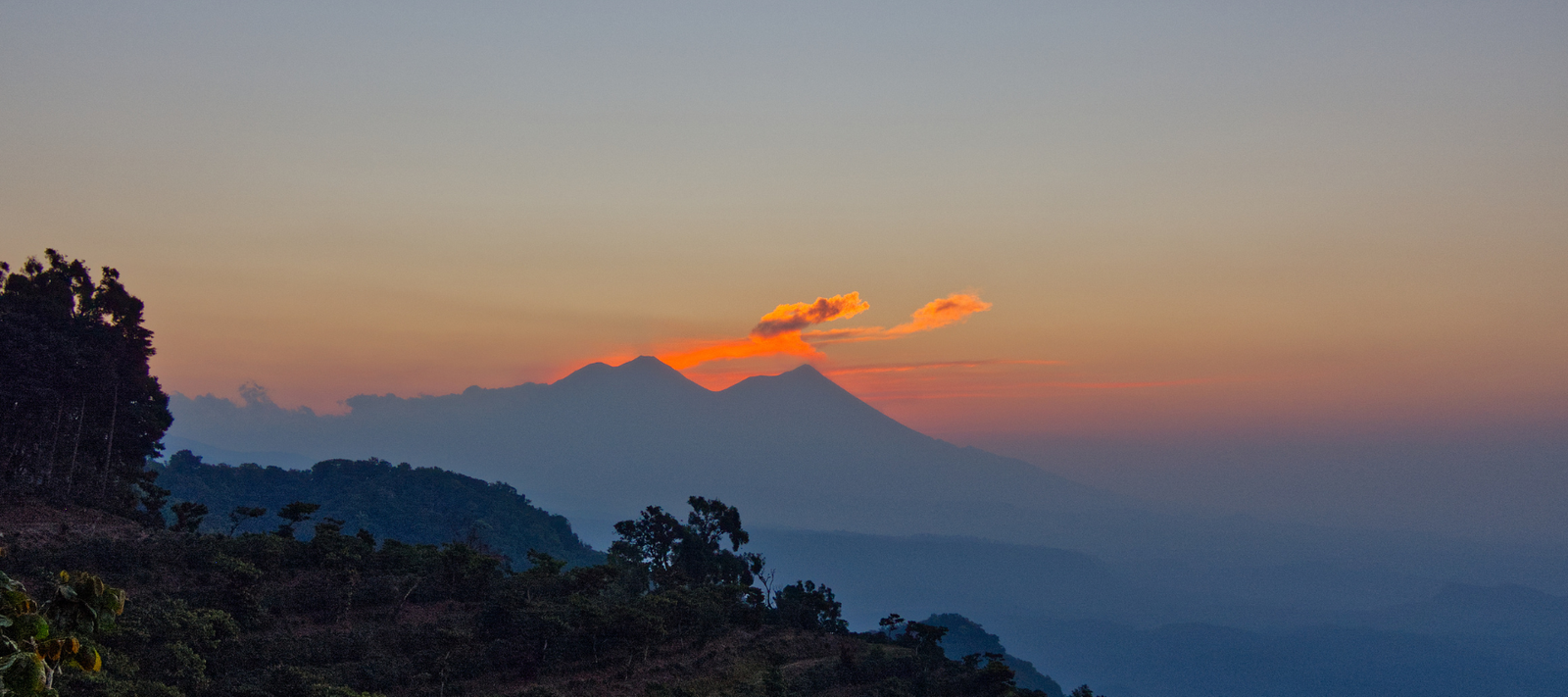

Perhaps you've heard that my colleagues Joris, Johannes, and I (David) spent the second half of February traveling in Guatemala and El Salvador. Our primary goal was to expand our knowledge of coffee production—and the countries where it takes place—as well as to nurture existing contacts and build new ones. On-site, we were able to visit several farms and processing stations. The timing of our trip was quite ideal—we arrived at the end of the harvest season and were thus able to observe the complete process from harvesting, through processing, to preparation for export. For me personally, this trip resulted in a profound shift in perspective for various reasons. But what exactly do I mean by that?
Well, it's the rough edges of an entire narrative block that are smoothed out with a detailed look into global realities; but that's also exactly where solidary thinking is prepared—in the details that initially push unnoticed to the edge of the frame, only to surreptitiously become the norm. As a former literary scholar loyal to Foucault, I am, of course, firmly convinced that power is solidified in discourses; but one can also read this logic from the other perspective: power structures can be broken down through language. This becomes clear in a political context: it's not surprising, for example, that authoritarian regimes generally censor strictly.It's a jumble of reasons, considerations, reflections, and thoughts that constantly resonate with me when I deal with my own perspective on the world of coffee, especially during the recent origin trip. Therefore, it's always important for me to consider these thoughts, which can only originate from the conditions of my own understanding of the world, which is why it can be worthwhile to share them with you for context.
But we don't have to keep it that academic, because we formulated our first takeaway from our trip already on the flight back: Coffee production, as we saw on site, is not the work of a single person. At every point of production, countless people are involved, all doing hard physical labor, contributing with a lot of expertise and experience to carry out the work steps in such a way that they ultimately contribute to the common goal - and that is quite clearly formulated: as much coffee as possible of the best possible quality should be produced. This is only possible if every step is reliably executed. That's why in the future we will pay even more attention to naming our coffees after the farms where they are produced - and no longer after individuals. It sounds trivial at first, but what we actually want to do here is to communicate the spirit of community on the farms, as we perceived it, as a matter of course.
What else was our trip? A painful reminder that climate change is a tangible global problem. I'll be honest - I've always perceived climate change primarily as a (real, to be clear) looming threat. Sure, the seasons have become a little less reliable and annoying over the course of my life, but not yet dangerous. It's a completely different story in areas where a sensitive crop like coffee plays a significant role in socio-economic life. The alternation between rainy and dry seasons is of massive importance; not only because cultivation techniques are based on it. Fertilization should ideally be done before the rain, harvesting afterwards. If the rain fails, comes too early, or too late - all these are massive disruptions to a time-critical work process. And that's not even mentioning rising temperatures, which - and this should really no longer be a secret - can have catastrophic effects on ecosystems.
Now, it's not as if producers fatalistically wait for the day when the weather becomes uncontrollable—quite the opposite. Coffee producers respond to challenges of this kind with astonishing adaptability. In one nursery, we observed how sensorially extraordinarily exciting Arabica varieties were grafted onto more robust Canephora rootstock. The advantage is obvious—the Robusta root provides the plant with more nutrients and anchors better in the soil—it protects against erosion or overwatering. Of course, harvesting rhythms are also adjusted, and experiments are conducted with different varieties. The tenacity and creativity with which coffee producers resist such profound problems are impressive. That they are in a situation where they have to do so is the real catastrophe.
 And what about questions of social justice? This is an aspect that, to be honest, I find difficult to judge. I am a child of a specific society, specific value contexts. I find it difficult to find the right balance between Eurocentrism and cultural relativism; precisely because the topic, from my personal perspective, trained and shaped by (West) German social science discourses in an academic household of the post-68 generation, is obvious. First of all, it is striking that sustainability is indeed an issue locally - but the question of transparency seems to be a consumer issue. The producers we met are not concerned with visibility - but with a reliable, preferably good income. Of course, there are exceptions, but we perceived this as the norm; be it through direct statements, but also through incidental observations. It is usually secondary whether a lot receives massive visibility as a competition coffee, or ends up as a field blend in a container that is then sold spot - the main thing is that the cash flow is right. I consider this a sensible, because reliable and measurable, metric - also, of course, because I have direct insight into the supply chains, and I also know that the distribution is fair. However, this does not mean that the issue of transparency becomes less important for us - it is primarily the conviction that through transparency we contribute to making the supply chain globally more understandable, more tangible, and that there is added value in that. The effects of this added value flow back as increased revenue, but the contextual classification and interpretation are up to us. Transparent action is not a service to the producers - but an active contribution to improvement.
It became really diffuse when it came to concepts like freedom and, closely related, security. First off: we never had any security concerns—but we were, of course, almost always accompanied by locals. However, already in Guatemala there were moments that were somewhat unsettling; for example, the security guard of a hotel complex patrolling the paths with a pump-action shotgun at the ready. At night, individual shots could be heard; further away, we couldn't find out what the cause or outcome was, life continued the next morning as usual. The questions on our side remain, but probably say more about us than about Guatemala.
It became truly obvious in El Salvador. The authoritarian president Nayib Bukele succeeded in his first term in reducing the country's murder rate—one of the highest worldwide at the beginning of his legislature—by more than 80%. This sounds like an impressive figure at first, but such effects usually don't just happen without further ado. To achieve these figures, a state of emergency was declared, a highly modern prison complex with space for 40,000 inmates was built, procedural rules for gigantic mass trials were developed, an entire city was besieged by the military to carry out a large-scale raid. A daily newspaper, after accusing Bukele of collaborating with gangs at the beginning of his term, was hit with money laundering proceedings—and we heard from other importers that Salvadorans are currently reluctant to discuss politics as soon as a smartphone is in the room. And parallel to this, the number of disappeared persons exceeds the number of murdered—but disappeared persons are recorded differently. Human rights organizations therefore have some doubts about how reliable the current rate is. El Salvador is currently on a worrying political path—that's my interpretation.

The crucial point, however, is not to desperately interpret the political well-being of other nations—quite the opposite. The task is probably to resolve such tensions in a way that avoids the two aforementioned poles of Eurocentrism and cultural relativism—we must understand what we have to endure. Perhaps this begins with clarifying the fact that a global supply chain will not inherently make the world a better place. No one along the supply chain needs visitors from consumer countries to validate or even save origins. And with that, it is relatively clear what our responsibility in this chain is: we must pay fairly. Everything else is none of our business for now. Only transparency, mapping and participation in it, as well as our ever-evolving self-understanding, can we pass on to you beyond that and invite you to a dialogue.